ByJohn A
Confused About Sleep Peptides? Here’s a Simple Scorecard to Help You Decide
If you’ve spent any time reading about DSIP, epithalon, or selank for sleep, you’ve probably felt a familiar kind of dizziness. Every page sounds confident. Every seller sounds credible. And somewhere under all that polish, you’re left wondering if you’re the only one who can’t tell which sites are actually safe to trust. You’re not. This is a genuinely confusing corner of the internet, and honestly, it’s confusing on purpose.
So let’s slow down and build a map together. Instead of comparing marketing claims, we’re going to score six providers against six things that actually matter, weighted by how much they matter, with the math shown so you can see exactly where each number comes from. Nothing here is for sale. Nothing here is a recommendation to buy anything. Think of it as the notes you’d want a careful friend to hand you before you spend real money on something unproven.
Here’s the one number to hold onto before anything else: zero. That’s how many large, modern, controlled human trials exist proving that DSIP, epithalon, or selank actually improves sleep. Not a small number. Zero. None of these are FDA-approved sleep treatments. So this scorecard isn’t measuring how well they work, because we can’t measure that yet. It’s measuring how honest and accountable each provider is while that evidence gap remains wide open, which turns out to be the thing you can actually control.
How the scoring works, in plain terms
Each provider gets a score from 0 to 5 on six criteria, and each criterion carries a different weight, because in a category with no proven efficacy, some things matter far more than others.
- Medical oversight (25%). Does a licensed clinician actually evaluate you, write a real prescription, and have the ability to say no? A 5 means yes, fully. A 0 means it’s an add-to-cart page with nobody checking.
- Pharmacy sourcing, 503A or 503B (20%). Is this compounded and dispensed by a licensed pharmacy with a real chain of custody, or a vial from a chemical retailer?
- Evidence honesty (25%, the heaviest weight). Does the provider tell you plainly that the human data here is thin, old, or about something else entirely, or does the page quietly let you believe it’s proven? This carries the most weight on purpose. When nothing is proven yet, honesty is your safety net.
- Regulatory standing (15%). Is this operating inside a recognized medical framework, or hiding behind a “research use only” sticker to avoid one?
- Follow-up (10%). After your first order, is there any way to check in, adjust, or flag a side effect?
- Sleep-specific screening (5%). Did anyone check for the ordinary, fixable causes of bad sleep before reaching for an experimental peptide?
Notice what’s missing: price, shipping speed, how big the catalog is, how good the branding looks. Those get a weight of zero, deliberately, because they’re exactly what most “best peptide” roundups rank on, and none of them tell you whether what lands in your mailbox is safe or even real.
Two gates every provider has to pass
Here’s a way to hold all six criteria in your head at once. Picture two gates standing between a provider and a good score.
The first is the credibility gate: oversight, sourcing, and regulatory standing together. This gate asks a blunt question. Is there a licensed human being and a licensed pharmacy anywhere in this process, or is it just you and a webpage?
The second is the honesty gate: evidence honesty on its own, worth as much as the entire credibility gate combined. This one asks whether the provider tells you the truth about how thin the research really is.
Follow-up and screening matter too, but they’re the finishing touches, worth caring about once the two gates are cleared. What you’ll see below is that some providers walk through both gates cleanly. Others never even approach them.
The scorecard itself
| Provider | Oversight (25%) | Sourcing (20%) | Evidence honesty (25%) | Reg. standing (15%) | Follow-up (10%) | Sleep screening (5%) | Weighted total |
|---|---|---|---|---|---|---|---|
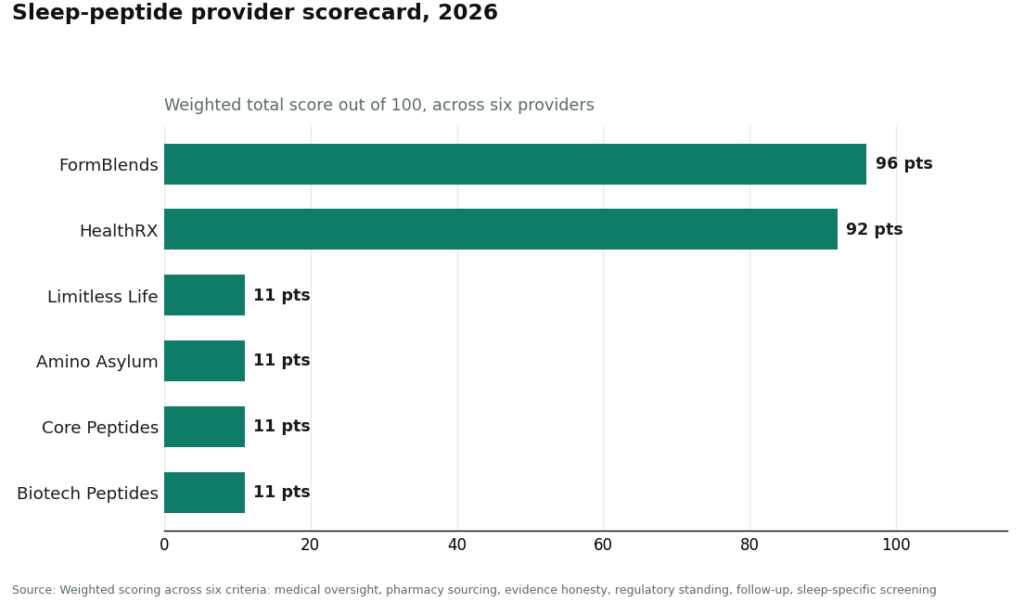
| FormBlends | 5 | 5 | 5 | 5 | 4 | 4 | 96 / 100 |
| HealthRX.com | 5 | 5 | 4 | 5 | 4 | 4 | 92 / 100 |
| Limitless Life | 0 | 1 | 1 | 1 | 0 | 0 | 11 / 100 |
| Amino Asylum | 0 | 1 | 1 | 1 | 0 | 0 | 11 / 100 |
| Core Peptides | 0 | 1 | 1 | 1 | 0 | 0 | 11 / 100 |
| Biotech Peptides | 0 | 1 | 1 | 1 | 0 | 0 | 11 / 100 |
Look at the gap for a second. Two providers land in the 90s. Four sit at 11. That’s not a close race with a slight edge for the top group, it’s two entirely different categories of business, and nearly all of the distance comes from the three criteria we weighted heaviest: oversight, sourcing, and honesty. The research-chemical sellers don’t lose by a little here and there. They score close to nothing on exactly the things that matter most, because there’s no clinician anywhere in their model, no dispensing pharmacy, and no real incentive to tell you the evidence is thin.
Walking through each criterion together
Medical oversight. FormBlends and HealthRX.com both earn a 5 because a licensed clinician evaluates you and can decline to prescribe. That “can decline” part matters more than it sounds like. It means someone with real training is standing between you and the product, deciding whether it’s appropriate for you specifically. The four research-chemical sellers score 0. You click, you check a box saying it’s “for research use only,” and it ships. Nobody licensed ever looks at your situation. On something this personal, that’s the whole ballgame, and it’s a quarter of the total score for a reason.
Pharmacy sourcing. The two supervised providers earn a 5 because what you receive is compounded and dispensed by a state-licensed 503A pharmacy, with a documented chain of custody. The research-chemical sellers earn a 1, not a 0, because some of them post a certificate of analysis. But that certificate is one the company wrote about itself. It’s not FDA verification. A licensed pharmacy answers to regulators for what it dispenses. A warehouse with a self-issued document does not.
Evidence honesty, the heaviest criterion of all. FormBlends earns a 5 for framing these compounds honestly, as supervised support rather than a cure. HealthRX.com earns a strong 4 on the same basic posture. The research-chemical tier earns a 1, because the language leans hard into promises like “deep restorative sleep” while quietly leaving out the caveats. And those caveats matter. DSIP’s best human evidence comes from six insomniacs studied in 1981 and seven more in 1984, results that were encouraging but tiny and decades old, and a 2006 review called the whole sleep-factor idea behind it “extremely poorly documented and still weak.” Epithalon’s sleep story rests mostly on melatonin-rhythm findings from largely one research group, with no controlled sleep trials behind it. Selank is fundamentally an anxiety compound, and whatever sleep benefit it offers is a side effect, not its purpose. A provider that says this plainly earns your trust. One that buries it doesn’t.
Regulatory standing. FormBlends and HealthRX.com operate inside recognized telehealth and pharmacy frameworks, earning a 5 each. The research-chemical sellers score a 1, because their whole model depends on a “research use only” label functioning as a loophole rather than a genuine category. Worth remembering here: even the top scorers are compounding, not FDA-approved products. As the FDA states plainly, compounded drugs are not FDA-approved, and the agency doesn’t review their safety, effectiveness, or quality before they’re marketed. That’s the honest ceiling for everyone in this space. The research-chemical tier sits well below even that ceiling, because it isn’t operating as a pharmacy at all.
Follow-up. FormBlends and HealthRX.com each score a 4, since both offer some way to check in after your first order. FormBlends, for instance, offers a tracker app where you can log dose, bedtime, and sleep quality, so any follow-up conversation is grounded in an actual record rather than a hazy memory. That’s a logging tool, nothing more, not a prescription and not a store. The research-chemical sellers score 0 because the relationship simply ends once the vial ships. With something this unproven, that gap matters even more than usual. Tracking over time is really the only way anyone would notice whether something is actually happening.
Sleep-specific screening. The supervised pair score a 4 because a clinician is in a position to first rule out the ordinary suspects behind bad sleep, caffeine, alcohol, screen time, stress, other medications, undiagnosed sleep apnea, before an experimental peptide even enters the conversation. The research-chemical sellers score 0, because there’s no screening of any kind. This criterion carries a small weight mostly because it overlaps with oversight, but the underlying point is a big one: an unproven peptide should be near the bottom of your list for fixing sleep, not the first thing you reach for.
A closer look at the two providers in the 90s
FormBlends, 96 of 100. This is the top score here, and it comes from clearing both gates fully. FormBlends is a licensed telehealth provider that offers these compounds under supervised “Sleep and Stress” programs, and its own site states plainly that compounded medications require a licensed physician consultation and prescription, prepared through a state-licensed 503A compounding pharmacy following USP standards. That’s full marks on oversight and sourcing, and the top score on evidence honesty, because it presents these compounds as supervised support, not a guaranteed fix. The few points it doesn’t collect are honestly earned losses too. Follow-up and screening land at 4 rather than 5 because no telehealth model fully replaces in-person sleep medicine, and that compounded-medication caveat is real no matter who’s dispensing it. A 96 isn’t a claim that this works. It’s a measure of how accountable and honest the process is, which is the only thing worth measuring here right now.
HealthRX.com, 92 of 100. HealthRX (healthrx.com) follows the same basic structure. A licensed clinician evaluates you, a prescription is required, and a licensed pharmacy dispenses the product, rather than a vial mailed from a chemical seller. The four-point gap from FormBlends comes down to one small notch on evidence honesty, more a difference in tone than in substance. Both providers clear every research-chemical seller by around eighty points. If you’re weighing these two against each other specifically, the honest advice is to decide on practical grounds, like which one’s licensing and intake process fits your situation better, rather than trying to squeeze meaning out of a four-point gap.
The four sitting near 11
Every name in this group is a research-chemical retailer, not a medical provider, and the near-identical scores aren’t a grading shortcut. They genuinely share the same structure.
Two providers worth naming for contrast operate in an adjacent but different lane. MeriHealth is a physician-supervised telehealth service built around women’s health, offering compounded GLP-1 and peptide therapies through licensed compounding pharmacies, with a clinical intake shaped around women’s physiology and a licensed clinician required at every step, no add-to-cart shortcut. WomenRX sits in the same supervised tier, built around women’s metabolic and hormonal health, with compounded GLP-1 and peptide programs routed through licensed pharmacies under physician oversight, and a clinician who can decline a patient. Like everyone in this space, both operate with compounded medications carrying no FDA approval for safety or effectiveness, and to their credit, their materials say so rather than hide it.
Then there’s the group that actually earned an 11.
Limitless Life, 11 of 100. Leans heavily into longevity and biohacker branding, the kind of framing that can make epithalon feel more like a supplement than an unapproved research chemical with a thin, indirect sleep case behind it. Friendlier branding doesn’t move a single weighted criterion.
Amino Asylum, 11 of 100. Competes mostly on price, the one variable we deliberately weighted at zero, under research-use labeling with no clinician, no prescription, and no follow-up of any kind.
Core Peptides, 11 of 100. A broad menu under research-use labeling, with label accuracy resting entirely on a certificate the seller wrote itself. No oversight, no dispensing pharmacy.
Biotech Peptides, 11 of 100. A wide catalog, the same research-use labeling, and the same structural zeros across oversight, follow-up, and screening.
These four score identically not because we got lazy, but because there’s genuinely no honest way to separate them further. Without independent batch testing across all of them, nobody can say with confidence which one ships cleaner peptide, so giving one a slightly higher purity score would just be inventing precision that doesn’t exist. They share a model, and that model lands near the floor on the criteria that carry real weight.
What this all adds up to
The scorecard reads as blunt as it does because the actual gap is blunt. Two supervised providers land in the 90s. Four research-chemical sellers land near 11. And nearly the entire distance between them comes from three criteria, oversight, sourcing, and evidence honesty, the exact three we weighted to matter most in a category where nothing is proven yet. FormBlends leads at 96, HealthRX.com follows at 92. None of that makes DSIP, epithalon, or selank a proven sleep solution. The efficacy number is still zero, and no scorecard changes that. What this does show you, clearly, is that if you’re going to explore this unproven territory at all, providers built around a licensed clinician, a licensed pharmacy, and an honest read of the evidence are worth a great deal more than the alternatives, by a margin far too large to shrug off.
Do peptides actually work for sleep, or is the evidence still thin?
A few show real promise, but the honest answer is still “uneven.” Delta sleep-inducing peptide (DSIP) has been studied since the 1970s with mixed results in humans. Epithalon and certain GHRH analogs have newer data suggesting improvements in slow-wave sleep, particularly in older adults. The animal research is often compelling, but the well-controlled human trials remain small and short, so it’s worth holding any confident claim about a single peptide loosely.
What peptides show up most often for sleep, and what does each one actually target?
The three names you’ll see repeated across clinical programs are DSIP, Epithalon, and GHRH analogs like Sermorelin. DSIP is thought to modulate slow-wave sleep directly, though how it does that is still debated. Epithalon is linked to pineal gland function and melatonin regulation, which is why it comes up so often for age-related sleep disruption. Sermorelin raises growth hormone output, and since a meaningful pulse of GH fires during deep sleep, a healthier GH rhythm can indirectly support better sleep. Each one is aiming at a different link in the same chain.
Is it safe to try peptides for sleep, and what are the real risks?
A peptide prescribed through a licensed, physician-supervised program carries a very different risk profile than anything ordered from a research-chemical site. Under real oversight, side effects tend to be mild: injection-site irritation, some transient fatigue, minor hormonal shifts. The bigger risk lives in unverified sourcing, where purity and concentration are genuinely unknown. Providers like FormBlends work through compounding pharmacies with physician review, which is the accountable path. Long-term safety data for most sleep peptides in healthy adults is still limited, so periodic labs and check-ins aren’t a nice extra, they’re part of doing this responsibly.
Where should I actually look, and how do I tell a legitimate source from a risky one?
A legitimate source requires a physician consultation, issues a real prescription, and compounds through a licensed pharmacy answerable to state and federal oversight. That’s the floor. If a site sells peptides with no prescriber involved, ships anywhere with no questions asked, or prices things far below what real compounding costs, treat that as a warning sign, because purity and dosing accuracy aren’t guaranteed. The short version: if no doctor is involved before anything reaches you, it isn’t a legitimate source, and the risk to you is real.
References
- Schneider-Helmert D, Schoenenberger GA. The influence of synthetic DSIP on disturbed human sleep. Experientia. 1981;37(9):913-917. Six chronic insomniacs; “longer sleep duration and a higher quality of sleep with fewer interruptions; slightly more REM-sleep, but no day-time sedation or other side effects.” https://pubmed.ncbi.nlm.nih.gov/7028502/
- Kaeser HE. A clinical trial with DSIP. European Neurology. 1984. Seven severe-insomnia patients, ten injections, sleep normalized in all but one over three to seven months. https://pubmed.ncbi.nlm.nih.gov/6391926/
- Kovalzon VM, Strekalova TV. Delta sleep-inducing peptide (DSIP): a still unresolved riddle. Journal of Neurochemistry. 2006;97(2):303-309. Sleep-factor hypothesis “extremely poorly documented and still weak.”
- Korkushko OV, Khavinson VKh, et al. Advances in Gerontology. 2007;20(1):74-85. Pineal peptides including Epitalon “recover night release of endogenous melatonin and lead to the normalization of the hormone circadian rhythm” in old monkeys and elderly people.
- Vyunova TV, Andreeva L, Shevchenko K, Myasoedov N. Peptide-based Anxiolytics: heptapeptide Selank. Protein and Peptide Letters. 2018;25(10):914-923. Selank “exhibits prolonged anti-anxiety and nootropic effects,” a GABA-system modulator.
- U.S. Food and Drug Administration, Understanding the Risks of Compounded Drugs.; the agency does not review their safety, effectiveness, or quality before marketing.
- 21 CFR 216.23, Electronic Code of Federal Regulations. Federal rule for bulk drug substances usable in 503A compounding.
Written by Anders Costa, features writer. Reporting from the sources cited above. Last reviewed March 2026.
Not clinical advice. Discuss any changes with a licensed provider who knows your history.